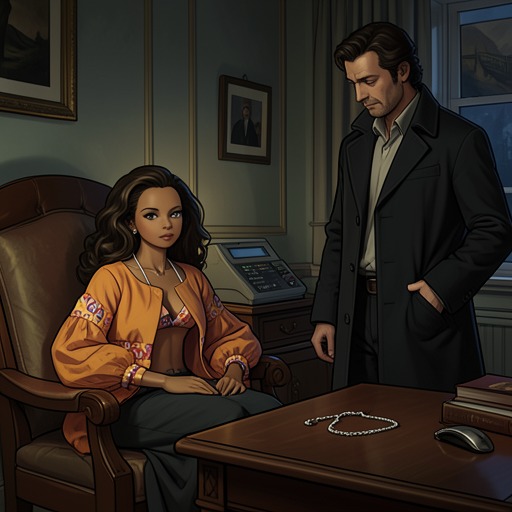
Marie Van Schuyler
Death on the NileMarie Van Schuyler is an elderly American traveler whose aristocratic bearing and habit of directing those around her make her a conspicuous presence aboard the Karnak. She treats Cornelia Robson as a subordinate poor relation, yet the later disclosure that she is a kleptomaniac complicates her public authority: the woman who insists that others protect her belongings is herself understood to be unable to resist taking things.
Identity and Setting
Marie is introduced during the crowded transfer from the train arriving from Cairo and Luxor to the Karnak. Poirot finds himself in a compartment with an elderly woman whose stiff white stock, numerous diamonds, and contemptuous expression distinguish her from the bustle around her. She gives him an aristocratic glare before retreating behind an American magazine. Across from her sits Cornelia Robson, a younger woman with an eager manner, whom Marie addresses with abrupt instructions.
Marie is traveling in Egypt, and her interest in the country is suggested by her reading a book about Egypt in the Karnak’s observation saloon. Her journey is not solitary: Miss Bowers accompanies her as usual, while Cornelia is also in her party. The account presents Marie through the visible signs of rank and command rather than through an explanation of her past. Her diamonds, formal appearance, and expectation of service establish her social position; no fuller biography is provided.
Authority and Everyday Conduct
Marie’s authority is exercised through small, specific orders. On the train she tells Cornelia to collect the rugs, look after her dressing-case on arrival, prevent anyone else from handling it, and remember the paper-cutter. The instructions make the preservation of her belongings a recurring concern, while their clipped delivery establishes an unequal relationship: Cornelia is expected to anticipate and meet Marie’s needs.
The same pattern continues aboard the Karnak. Complaining that the saloon is too hot, Marie orders Miss Bowers to find a chair on deck and Cornelia to bring her knitting, take care not to drop it, and wind the wool. The two women leave as a procession, with Marie at its center. Her demands concern ordinary comforts, but the scene gives them social weight: both attendants are treated as extensions of her routine rather than as companions whose own wishes need consideration.
Cornelia’s position is also framed by the assumption that she is a poor relation. When Cornelia speaks of having dreamed of a trip to Europe but never expecting to make one, Marie inclines her head with satisfaction at what the narration presents as the proper deference of a dependent relative. The moment suggests that the journey and its privileges are controlled by Marie, and that she expects gratitude to accompany them.
The Missing Stole and the Disclosure
Marie’s concern for her possessions becomes especially pointed when her velvet stole is found missing. After returning, Cornelia apologizes for taking time; Marie rebukes her for not hurrying and asks what she has done with the stole. She insists that it had been in the saloon after dinner, on a particular chair, and that she herself had not left the room. Cornelia searches, but the evidence here does not say where the stole went or who took it.
The explanation arrives much later through Cornelia, not through a confession by Marie. Miss Bowers has told Cornelia about her cousin and says she can no longer carry the responsibility alone. Dr. Bessner has been kind, Cornelia reports, and has explained that kleptomania can arise from a deeply rooted neurosis, sometimes connected with an incident in childhood. This disclosure identifies Marie’s condition through the account of others; the narrative does not supply the childhood cause or show Marie undergoing treatment. It changes how the earlier emphasis on guarded belongings and the vanished stole may be read, without establishing the fate of that particular object.
Cornelia is distressed not only by the condition but by the possibility of public exposure. She fears that the tabloids in New York would publicize the matter and bring disgrace upon Marie and the family. Race reassures her that the matter will remain private aboard the boat. The exchange shows that Marie’s standing is something her relatives are anxious to protect, even as her need for secrecy has become a burden Miss Bowers cannot manage alone.
Cornelia and the Closing Reversal
Marie’s relationship with Cornelia is not defined only by dependence. Near the end of the journey, Cornelia explains that she has been with Jacqueline de Bellefort, whom she felt was in an awful position confined with a stewardess. Marie is furious and threatens to send her home. Cornelia answers that she will not go home and is going to get married. Marie’s response treats the announcement as Cornelia finally having come to her senses. The exchange does not establish the marriage’s later course, but it marks a change in the balance between them: Cornelia states her own decision instead of simply accepting Marie’s orders.
Marie’s characterization consequently rests on a contrast between control and vulnerability. She guards her dressing-case, directs the handling of her rugs and knitting, and expects deference from a poorer relative; the revelation of kleptomania introduces a private compulsion that sits uneasily beside this command of others. At the same time, the disclosure is managed as a family secret, while Cornelia’s refusal to be sent away asserts a measure of independence within the relationship. Marie remains a secondary figure, but her missing stole and the concern surrounding her condition show how the journey’s apparently minor domestic incidents can conceal a more complicated personal reality.